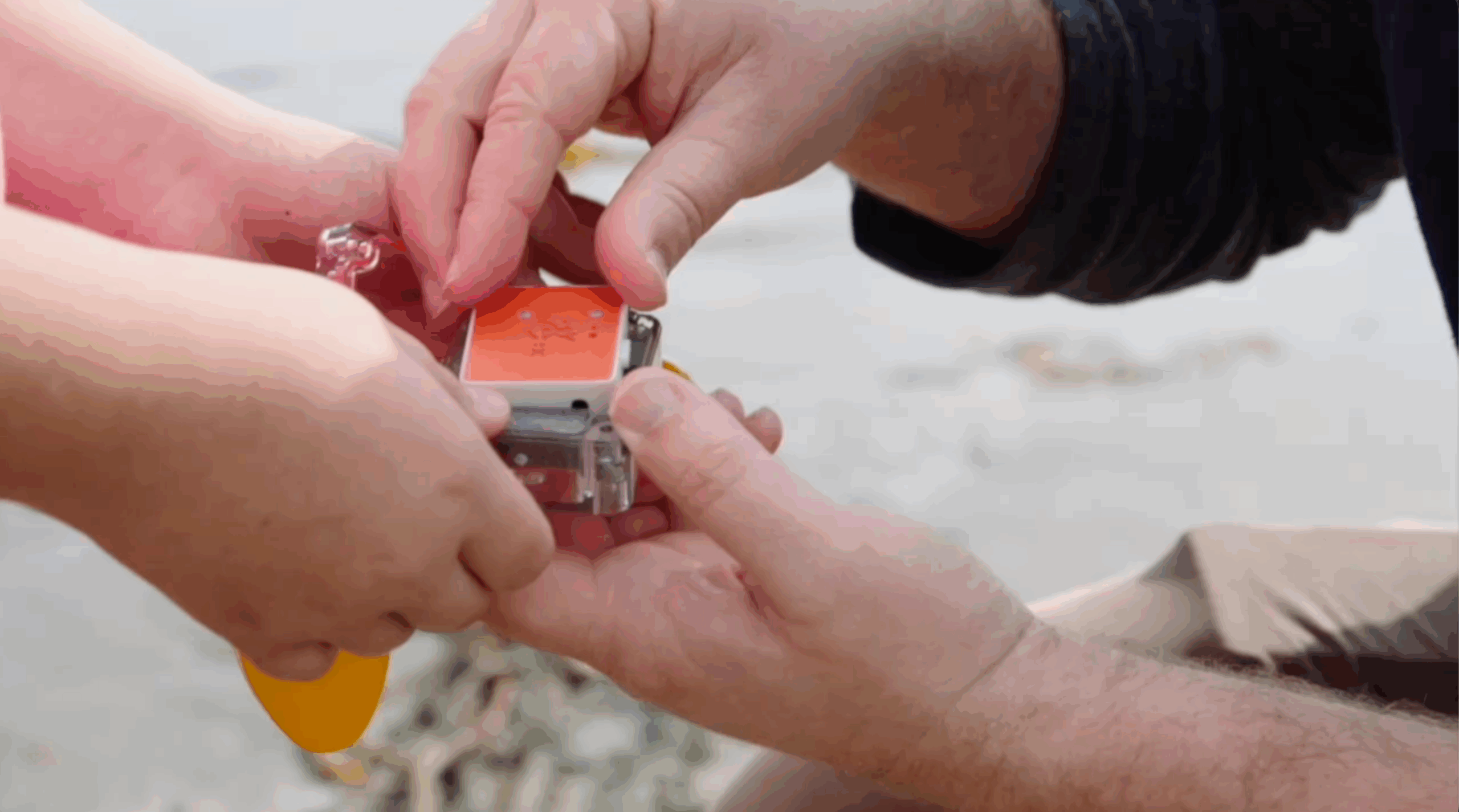
PocketLab’s journey from a Stanford-born idea to a global, hands-on science platform is now reaching a new milestone: putting a sensor into orbit aboard the International Space Station. Voyager Technologies is making that possible by serving as PocketLab’s implementation partner.
PocketLab was built on a simple belief: students learn science best by doing. Today, PocketLab’s integrated ecosystem of sensors, software, curriculum and virtual learning tools reaches more than 2 million students across approximately 20,000 U.S. schools.
That same philosophy extends to orbit. With a grant from the ISS National Laboratory, PocketLab will fly its lightweight, multi-function sensor, coincidentally called Voyager, to the ISS, enabling students on Earth to run the same experiments as astronauts in microgravity and directly compare the results.
Voyager: Where Vision Becomes Reality
Voyager is PocketLab’s implementation partner, executing the mission, drawing on a rich heritage supporting ISS missions and payload operations. The company has taken more than 36 nations to space, completing more than 1,400 missions, including 330 satellites.
Voyager’s role is to translate PocketLab’s educational objectives into a mission-ready payload and executable ISS experiment, bridging classroom innovation with the realities of human spaceflight. With a long history of ISS mission management, Voyager is supporting the program across every operational phase, including:
- Payload integration and safety certification, ensuring the PocketLab sensors meet ISS requirements, including battery modifications and operational constraints.
- System testing and validation, confirming Bluetooth connectivity and performance with approved ISS computing hardware.
- Crew procedures and experiment design, shaping activities that are meaningful for students while remaining practical within astronaut timelines.
- Launch readiness and on-orbit operations, managing packing, handover, activation and mission operations aboard the Space Station.
This partnership allows PocketLab to focus on educational impact while relying on Voyager’s proven ISS expertise to manage risk, complexity and execution.
Learning by Doing: On Earth and in Microgravity
The PocketLab sensor weighs just 20 grams and includes more than a dozen measurement capabilities, such as acceleration, rotation, temperature, humidity and distance sensing. Already used widely in middle- and high-school classrooms, the same device will now operate in microgravity.
Astronauts will perform simple, repeatable experiments aboard the ISS, while students conduct identical experiments on Earth. By comparing data sets, students will directly observe how gravity – or the absence of it – changes physical behavior, turning abstract concepts like free fall and motion into measurable realities.
Together, PocketLab and Voyager are turning the ISS into a live learning laboratory, connecting classrooms to orbit, translating real mission operations into student discovery, and inspiring the next generation of scientists, engineers and explorers through authentic spaceflight experiences.
Stay tuned for a 2026 launch!