A Commercial Space Economy Ready to Scale
The commercial space economy has reached what Voyager’s Chief Technology Officer Paul Tilghman calls “the shift from experimentation to industrialization.” Launch is more reliable. Autonomy is maturing. In-space systems are increasingly modular, reconfigurable and designed for real operational tempo, not slow, bespoke missions.
Across biotech, advanced materials, Earth observation, semiconductors, AI and national-security applications, companies are no longer asking whether space is useful. They’re asking how quickly space can support their roadmap.
All this activity relies on one structural truth: the space economy only functions when there is an operational destination.
“We’re entering an era where commercial space isn’t exploratory; it’s industrial,” said Matt Kuta, president, Voyager. “But industrial economies only scale when there’s infrastructure. The ISS has been that backbone for more than two decades. If we allow a gap in capability, we not only pause progress, we unwind it. Starlab ensures the momentum continues.”
The LEO Economy Depends on a Destination
Voyager’s CTO blog highlighted a critical shift: launch is no longer the bottleneck, but infrastructure and down mass are. Spaceflight is becoming destination and product driven. Without a station, commercial R&D pipelines stall, autonomous systems have nowhere to mature and microgravity manufacturing cannot scale beyond prototypes. The result is what Tilghman describes as the “capability throughput problem.” If industry cannot run missions frequently and reliably, it cannot grow.
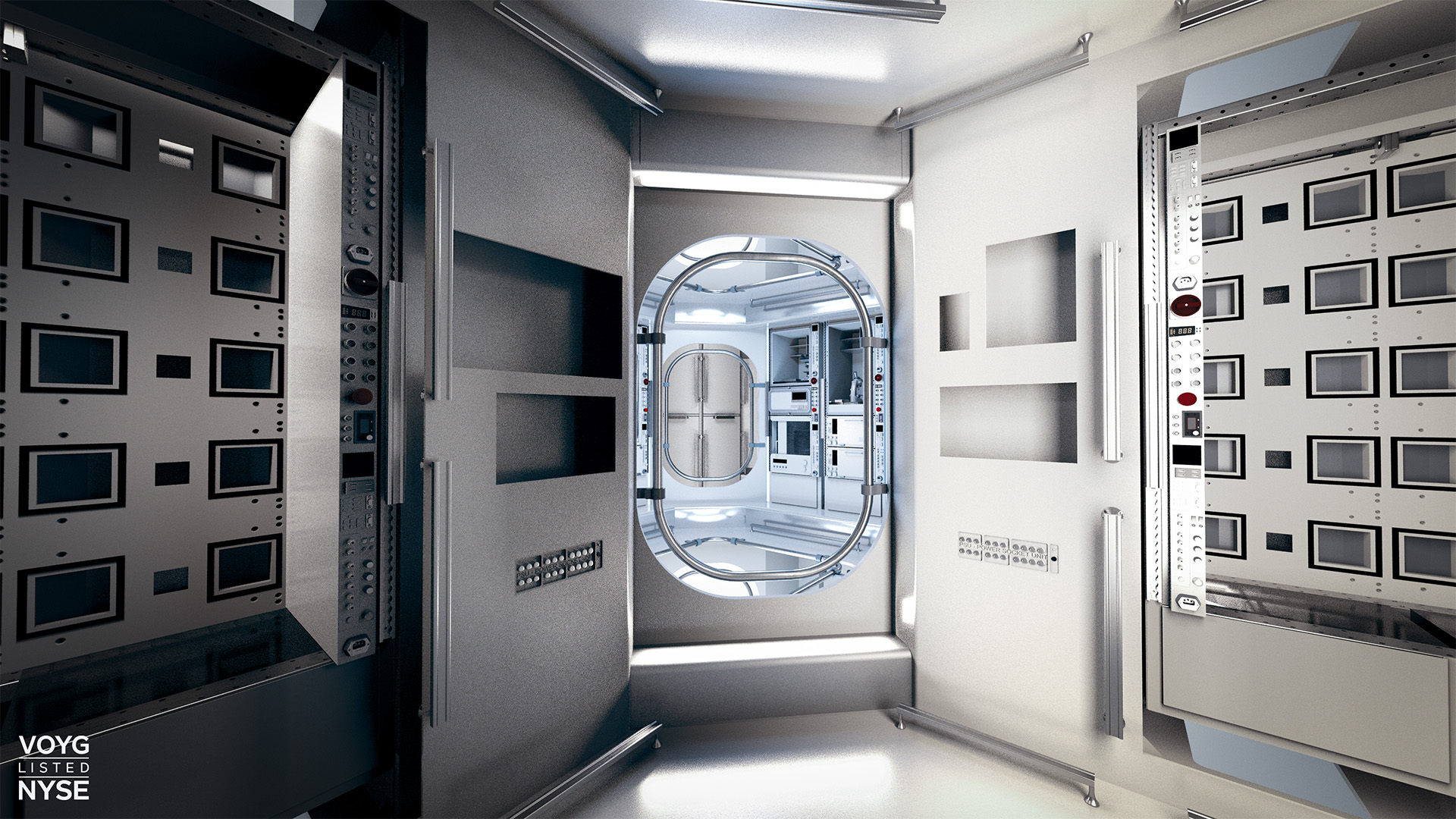
Starlab is built to solve this. Designed for continuous human presence, modernized internal volume and simultaneous multi-industry operations, it enables predictable access, repeatable missions and the sustained utilization required for a real orbital marketplace, not episodic experiments.
”Delivered in a single launch, Starlab provides pressurized volume and R&D capacity equivalent to the ISS, ensuring the continuity of ongoing ISS research,” said Dr. Luis Zea, chief scientist, Starlab Space. “Beyond that, it introduces new, first-of-their-kind capabilities that enable exponential growth, unlock entirely new scientific and commercial opportunities, and establish Starlab as the foundational platform on which the next generation of space-based businesses and discoveries will be built.”
Starlab’s architecture reflects deliberate alignment between science and commerce, shaped by decades of ISS experience and led by Dr. Zea. It is backed by deep operational expertise across its partners: Voyager’s mission-management heritage, Airbus’s engineering acumen, MDA’s on-orbit robotics experience, Mitsubishi’s market growth, Space Applications Services’ payload expertise and Palantir’s AI.
Starlab is not a conceptual platform waiting for commercial need. It’s a commercial platform being built because the need already exists. Engagement with government agencies, global partners and commercial customers is translating into mission requirements, utilization plans and contracted opportunities.
Starlab is the foundation of the first scalable orbital marketplace
More than a bridge between eras, Starlab is the backbone of a diversified, multi-sector marketplace. It is the only platform capable of sustaining human presence, protecting research pipelines, enabling commercial manufacturing and ensuring no gap in capability when the ISS retires.
Starlab enables microgravity manufacturing to evolve from pilots to production. It provides a stable environment for biological, materials and semiconductor processes that have no terrestrial equivalent. It accelerates research and development with reliable, crew-tended access. It supports autonomy, robotics, in-space servicing, Earth observation and advanced sensor development. And with a global partner ecosystem, it brings international customers and capital directly into the LEO economy.
“Starlab is a company, commercial ecosystem and space station in one,” said Brad Henderson, chief commercial officer, Starlab Space. “We’re building the business infrastructure that will anchor the next era of the orbital economy. Market demand is shaping our requirements in real time, and those signals are driving directly into our design. Starlab is being built to serve the science, manufacturing and mission needs of today and those that haven’t been invented yet.”
The next chapter of orbital commerce begins with Starlab. Without it, the market contracts. With it, a new industrial era in low Earth orbit becomes possible.