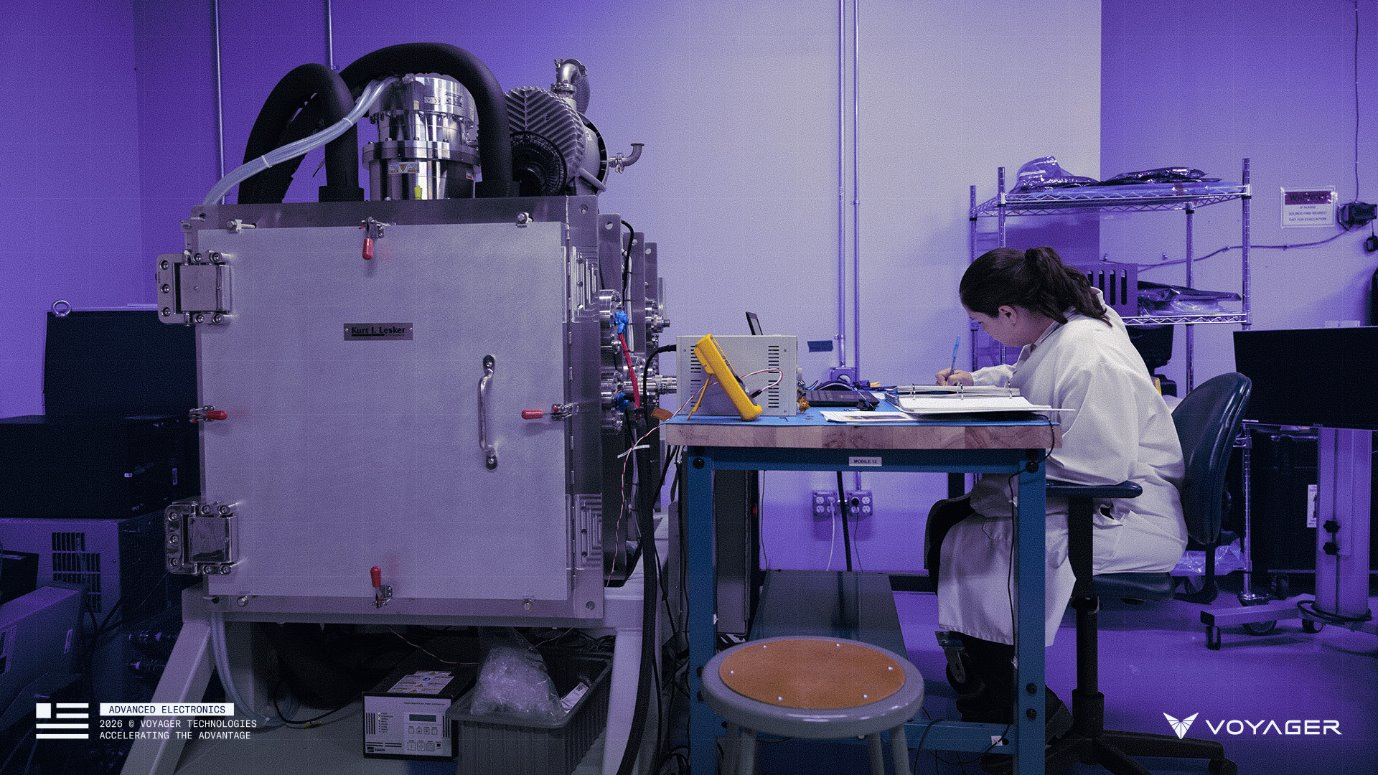
Voyager delivers rad-hard and flight-proven systems for demanding missions
The orbital environment is brutal and also home to satellites and proliferated constellations powering critical missions across navigation, Earth observation and global communications. The electronics underpinning it all need to be able to withstand the pressures of launch vibration, radiation exposure and thermal extremes in a vacuum where heat cannot simply be blown away.
“Space and defense programs depend on electronics that are built to meet the high-assurance requirements of the most demanding missions,” said Matt Magaña, president of Space, Defense and National Security, Voyager. “Voyager takes the full mission environment into account and builds with that perspective so we can deliver rigorously designed, flight-proven advanced electronics that perform in orbit and beyond.”
Communications and Digital Systems
Voyager’s communications and digital systems are built around flight-proven performance and on-orbit adaptability.
Software-defined radios and lunar transponders support telemetry, tracking and command, mission-data transmission and signals intelligence across the full range of mission profiles. The ability to reprogram modulation and frequency on orbit means a single asset can adapt to an evolving threat environment without replacement. Laser Communications Terminals extend that capability with high-throughput, low probability-of-intercept connectivity, making it well-suited for contested environments where traditional RF links create exploitable signatures.
The Nanocom SDR illustrates Voyager’s communications capabilities in action. It’s a miniaturized, software-defined radio designed for extreme environmental conditions. Nanocom SDR is programmable on-orbit and built around a Xilinx Zynq System-on-a-Chip, whose programmable logic resources support sophisticated on-board algorithms. It supports encryption, network protocols and on-board storage. The modular design provides flexibility in modulation, channel frequency and data rate, all reconfigurable after launch. Nanocom can be used for narrowband or wideband operation and is the building block for multiple configurations.
Underpinning these capabilities is Voyager’s modular, radiation-hardened digital processing systems. Spanning space processors, avionics platforms and image processing computers, these digital processing systems are fully configurable to mission requirements and reprogrammable on orbit.
Spacecraft Systems
Just as important as capability at the subsystem level is whether the broader spacecraft architecture can support those capabilities. Voyager’s spacecraft systems provide structural reliability for demanding missions, regardless of platform size.
High-performance Power Processing Units form a critical backbone for gridded ion electric propulsion systems, which facilitate flexible in-flight throttling and support mission maneuverability. This allows for extended operations in contested and congested orbital
environments.
Earlier this year, the company expanded operations and the workforce at their Denver metro-area facility to double production of their satellite propulsion modules year over year, with plans in place to double them yet again. Each satellite propulsion module integrates a propellant tank, electronics controller, thruster and propulsion distribution system into a compact, high-performance solution that is engineered for precise orbital maneuvering, threat avoidance and sustained mission effectiveness.
Guidance, Navigation and Control
Voyager’s Vantage electro-optical system line is designed to achieve mission-grade precision in guidance, navigation and control without absorbing mass and cost penalties that small satellite programs cannot afford.
VantageCam is a low read-noise imaging solution with high dynamic range for precise detection of dim objects at a distance. Ideal for space domain awareness and high-resolution imaging, it’s
radiation-hardened and already supporting Artemis lunar, commercial and defense programs. With the addition of a lens, alignment cube and star-tracking software, VantageCam becomes VantageStar, Voyager’s American-made, radiation-tolerant star tracker. It delivers precise, low read-noise orientation determination for demanding missions. VantageSun rounds out the line-up as a zero-power, low-mass sun sensor that is built in America to support attitude determination through launch separation, emergencies and off-nominal modes. It’s a low-cost, low-mass sensor that draws no power.
“Our advanced electronics reflect our integrated approach to small satellite performance, where communications, digital processing, power management and precision navigation are engineered to work together from the ground up,” said Bob Pescatore, vice president general manager, Space Electronics, Voyager. “The SmallSat community is tasked with executing missions that were unimaginable on these platforms a decade ago, so electronics that are flight-proven, domestically sourced and built to field quickly is where the advantage lies.”