Advanced electronics built to fly and scale
It doesn’t take a catastrophic failure for a space vehicle’s mission to end. If a satellite, rocket or missile loses the ability to communicate or understand its orientation, its mission is likely over. A single underperforming component can cost time and money invested in design, launch and
operations, making the advanced electronics Voyager Technologies builds mission-critical.
The company’s suite of advanced electronics, spanning communications, digital systems and electro-optical sensors, comes with a documented heritage of performance across all orbits. They are built to meet the high-assurance requirements of the most demanding missions for civil, commercial and government space missions.
“Our value exists at the intersection of cost-effectiveness and high-performance,” said Matt Magaña, president, Space, Defense and National Security, Voyager. “Our ruggedized systems that power space exploration and missions are rigorously designed and tested to withstand the harshest environments, from launch vibration to radiation mitigation, yet our commercial model keeps prices accessible for customers.”
Proven on Orbit
Voyager’s advanced electronics team designs and sells space-rated hardware to major primes, space companies and directly to the U.S. government. The lineup covers three core product lines.
Sensors give a spacecraft the ability to see and orient itself in space and include cameras, star trackers and sun sensors. The flagship product is Vantage Star, a camera and star-tracker platform built around a 5-megapixel sensor, with the line now expanding toward 67-megapixel resolution and more flexible input/output configurations to fit a wider range of missions.
The compute product line covers the onboard computing systems that power a spacecraft’s operations like command and data handling, control electronics and onboard image processing before data is transmitted to the ground. The systems are built from modular boards — power supplies, processors and backplanes — that can be configured and combined to meet each mission’s needs.
Voyager’s line of radios, l, including transponders, transceivers and transmitters, enables crosslink and ground communications. The Nanocom software-defined radio can be configured to function as any of the three. The radios which are currently operating in orbit were designed and built by the same engineering team that is developing the new, state-of-the-art variants.
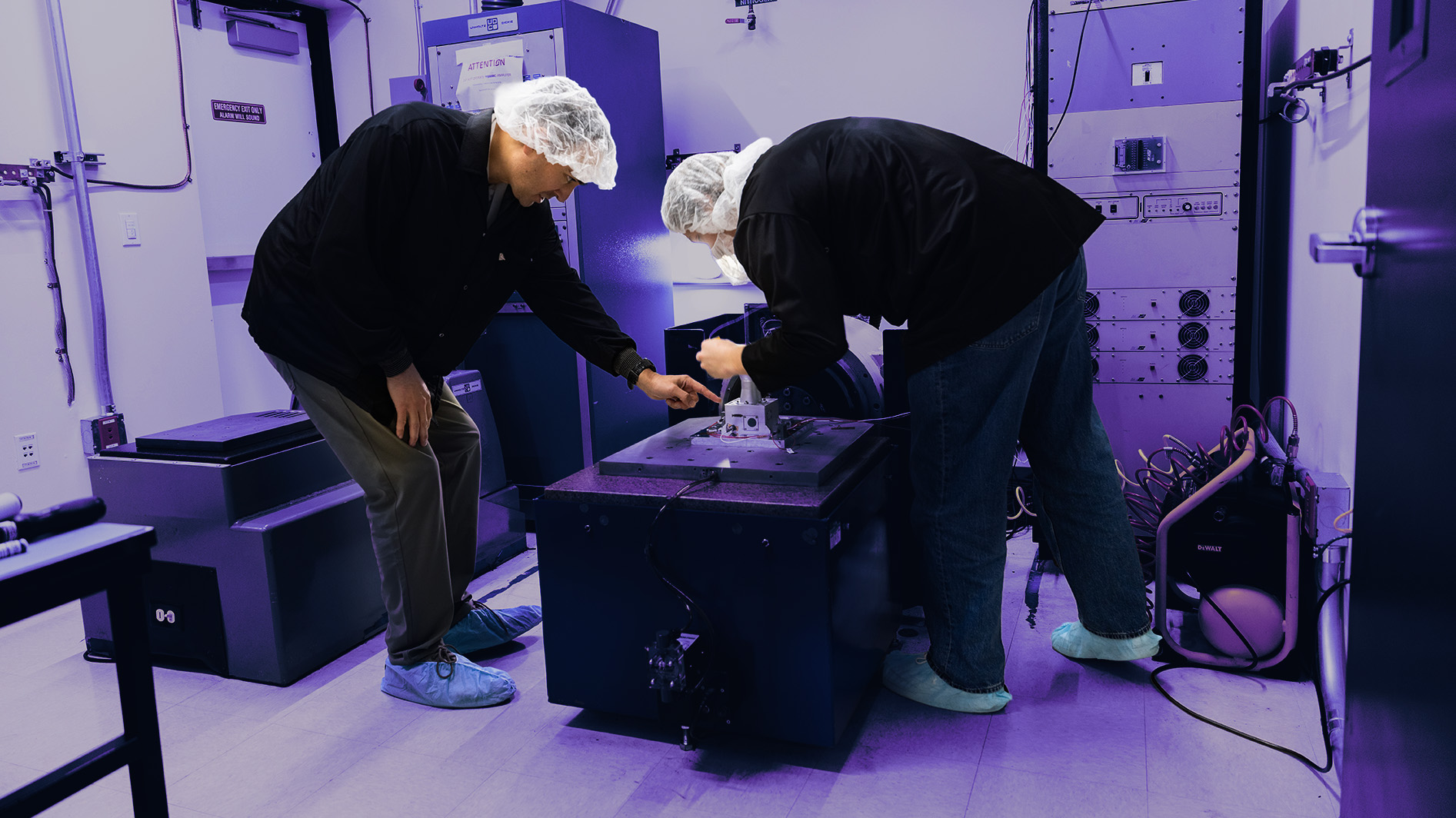
Every product is tested in Voyager’s labs in San Diego with thermal vacuum chambers and vibration tables, experiencing the same harsh conditions they’ll face during launch and operations. The company sets tight tolerances and nothing leaves the building unless it passes.
Scaling to Meet the Mission
Whether it’s for a lunar lander or an interceptor rocket for Golden Dome, space customers increasingly need hardware that can be delivered in months rather than years.
Voyager is adapting to deliver the speed and quality the mission demands, evolving toward a more standardized products model. One in which there is a catalog of pre-qualified, ready-to- ship products that customers can select from, cutting out much of the custom development cycle and the cost and lead time that comes with it.
The shift starts at the component level. Rather than redesigning core hardware for every program, Voyager is standardizing the building blocks, so they mix and match across sensor, compute and radio product lines. A single qualified power supply design can be reused across multiple products instead of being re-engineered each time. Fewer one-off designs means lower engineering overhead per unit, faster turnaround for customers and more predictable, competitive pricing.
On an operational level, Voyager has moved from producing small batches of three or four units at a time to preparing for production runs of 300 to 400 for some programs. A small engineering team could design, assemble and test a handful of units, but high-volume production requires a dedicated manufacturing team that can run repeatable, documented procedures, as well as automated testing. To support this growth, the company is actively hiring across engineering, supply chain, business development, program management and operations.
Physical capacity is a key piece of the scaling story as well. Voyager’s new facility in Long Beach, with its AI-driven manufacturing, will play a role in scaling the advanced electronics segment beyond what the current San Diego site alone can support.
“The additional production capacity across other expanding Voyager locations, like Long Beach, gives us room to grow into larger-scale manufacturing without disrupting programs already underway,” said Bob Pescatore, and general manager, Products, Voyager. “We’re well positioned to meet the industry’s demand for faster delivery timelines while keeping quality and pricing competitive.”