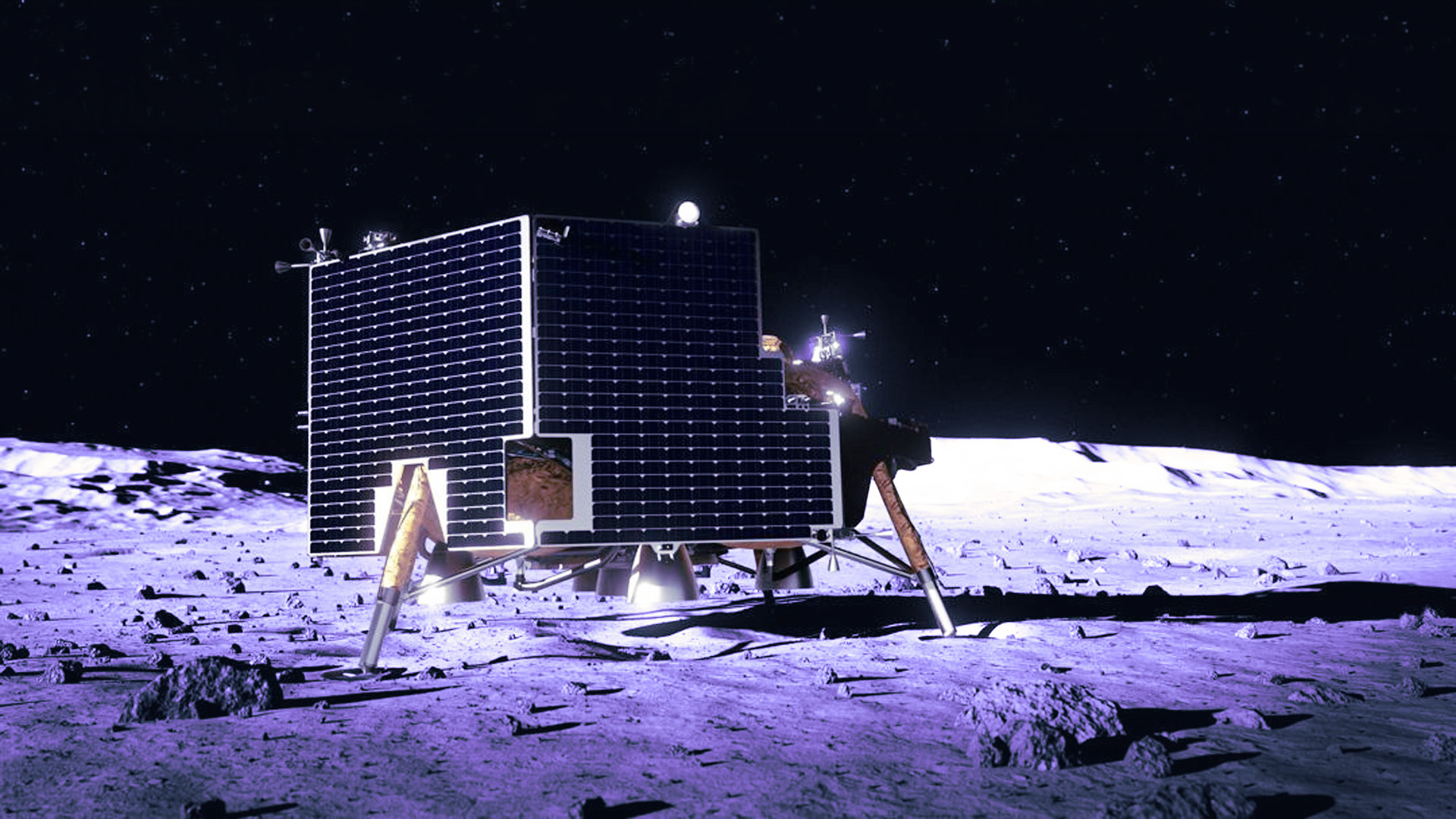
Voyager’s rigorous testing approach puts hardware and software through flight-like conditions before January launch
Griffin Mission One (Griffin-1), Voyager’s infrastructure-class lunar lander launching in January 2027, hasn’t left Earth yet, but it has already been put to the test. The company employs a “test like you fly” approach to every element of a lunar landing mission, from the lander to the landing itself. Sensors, software and hardware are all exercised in a flight-like environment to better understand how they will perform during every phase of the mission.
“The harsh lunar environment rewards preparation,” said John Thornton, executive vice president, Lunar Systems, Voyager. “The South Pole is one of the most demanding destinations and it’s where lasting lunar infrastructure will need to operate. We test like we fly because the mission demands that standard.”
The Lander
A lunar lander can be modeled and simulated countless different ways on a computer, but there’s nothing quite like putting the real thing in the conditions it will experience during flight. Once Griffin is in deep space, there’s no opportunity to open a panel to check a connection that shook loose during the vibration of launch or replace a component that became brittle in the freezing cold conditions. This is why Griffin-1 went on a cross-country journey from Voyager’s Pittsburgh facility to NASA’s Jet Propulsion Laboratory in Southern California to undergo a nearly three-month-long marathon of environmental testing, which wrapped successfully in late September 2026.
The Falcon Heavy rocket, which will launch Griffin-1, generates more than five million pounds of thrust at liftoff. That’s a lot of power and a lot of vibration. To replicate this environment, Griffin was subject to vibration, acoustic, electromagnetic and thermal vacuum testing. Together, these tests verified the workmanship of the integrated vehicle.
During vibration testing Griffin-1 was placed on a shaker table and rattled in three directions to simulate the vibration loads it will experience during launch.
Acoustic testing uses giant horns powered by compressed gaseous nitrogen to blast Griffin-1 with up to 153 decibels to replicate the roar of a rocket’s ascent.
Electromagnetic interference and compatibility tests assure Griffin-1’s avionics and payload suite can operate safely alongside each other, the launch vehicle and the broader mission architecture.
The longest test was performed inside the thermal vacuum chamber at JPL, which has supported historic lunar and deep-space missions like the Ranger, Surveyor and Mariner programs. Inside, the chamber cycled through thermal swings between 167 degrees Fahrenheit and minus 148 degrees Fahrenheit, simulating the extreme temperatures the spacecraft will experience during its mission.
The Landing
Environmental testing can validate Griffin-1 has what it takes to withstand launch, flight and landing, but touching down successfully on the lunar surface is a technical challenge of its own. A successful landing at the lunar South Pole requires advanced software and sensors that can work together under real landing conditions.
Griffin-1’s Guidance, Navigation and Control system combines several advanced technologies, including Terrain Relative Navigation, LiDAR-based Hazard Detection and Avoidance, and Navigation Doppler LiDAR. All these sensors must function together to guide the spacecraft safely and precisely to the surface. Voyager validates the components across three test platforms that cover hardware, software and mission operations.
The company’s Software-in-the-Loop platform runs more than 1,500 simulations across every mission phase. The same software used for the actual lunar landing is tested in these end-to-end descent and landing simulations across varied site topography, lighting and initial vehicle state so the team can build statistical confidence across a range of realistic lunar conditions. In the same way, sensors, flight avionics, and actuators are all tested and validated ahead of launch to ensure the highest probability of mission success.
“We test the nominal case, but we also deliberately introduce anomalies and stress scenarios,” said Dan Hendrickson, vice president of Business Development, Lunar Systems, Voyager. “We need to know how Griffin-1 behaves when conditions aren’t ideal. That data builds confidence in both the lander and the landing.”
Altogether, the campaigns test Griffin-1 piece by piece and as a whole system. The final verdict won’t be delivered until Griffin-1 conducts a soft landing on the lunar South Pole, but testing the way we fly means the closer the lander gets to launch, the more confidence the test results build.