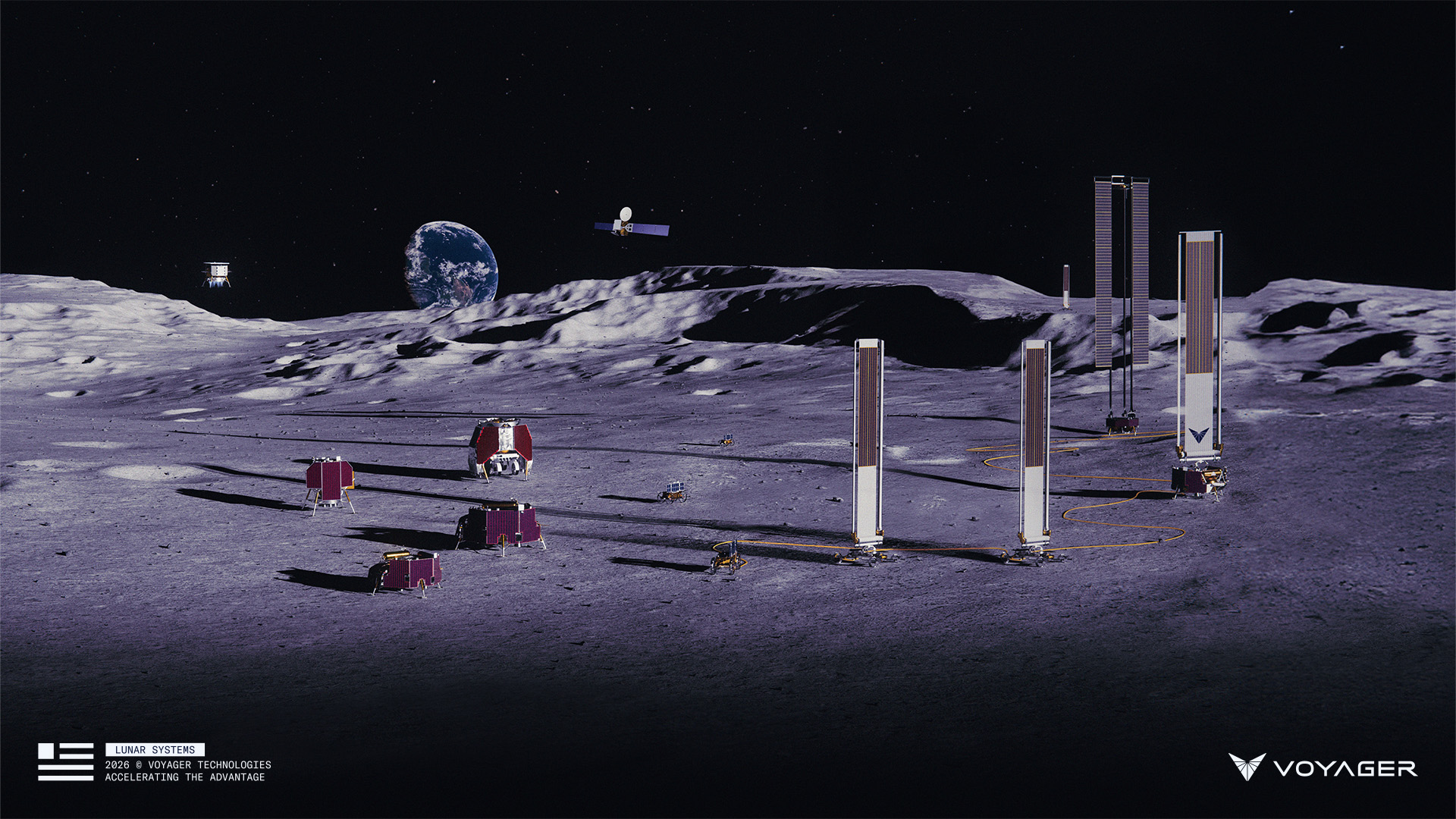
A permanent human presence on the Moon has only recently entered the public conversation as an achievable goal rather than a far-fetched ambition, but the technology and capabilities required to make it possible have been under development for much longer.
With nearly two decades of deep technical capability in landers, surface power, robotics and cislunar navigation, Voyager’s focus is to deliver the foundational infrastructure a sustained human presence in space and on the Moon requires. These systems coexist with capabilities spanning propulsion, advanced electronics, mission management and investments in the habitation layer, all coming together to form the most complete integrated commercial lunar infrastructure platform in the United States.
“We announced our lunar strategy in February, aligning ourselves with the national goal to deliver the foundational infrastructure required for sustained operations on the lunar surface,” said Dylan Taylor, Chairman & CEO, Voyager. “Six months on from that announcement, we have a dedicated lunar systems team, three planned landings on the Moon and the capabilities to deliver for NASA’s Moon Base plans and future deep-space exploration.”
Landers
Peregrine was the first lander under NASA’s Commercial Lunar Payload Services (CLPS) initiative and first U.S. lander since the Apollo Program. Peregrine is a small-class lander with the ability to deliver payloads to virtually any location on the Moon, including polar, equatorial, mid-latitude and near- or far-side locations. The lander has a customizable payload deck and a minimum of 192 hours of surface operations
Griffin is the company’s infrastructure-class lander, and as part of NASA’s Moon Base, scheduled to land on the Moon as early as 2026. Griffin comes in a range of configurations, offering payload capacity from 150 kilograms to 2,000 kilograms and providing three delivery options: lunar orbit, the lunar surface and mobility across the surface with rovers. Griffin-150 is the 150-kilogram option that offers an efficient path to lunar orbit or the surface for smaller payloads and missions where launch vehicle space is constrained. For mid-range payloads, Griffin-650 provides roughly 650 kilograms of capacity. Its wide stance and low vertical profile offer greater stability during descent and landing to better protect valuable payloads through a critical phase of the mission. Griffin-2000 is for missions requiring the greatest payload capacity. It’s optimized to deliver large rovers — up to the size of a compact car — and surface infrastructure to the lunar surface. It comes in two different configurations to better accommodate customer hardware and missions.
Both landers incorporate terrain relative navigation and hazard detection and avoidance sensors to enable safe, precise landings. They also come with the engineering support of the people who designed them and know them best. From payload integration through lunar operations, Voyager’s experienced team works alongside customers to implement payload and mission objectives and identify and solve potential challenges early in the mission.
Lunar Surface Systems
Landing on the Moon is only part of the challenge. The lunar night lasts 14 Earth days and can see temperatures drop as low as negative 300 degrees Fahrenheit. Making the Moon accessible and enabling a sustained human presence requires infrastructure that can withstand those harsh conditions.
LunaGrid is in development to help solve that challenge.
As the first commercial power service for the Moon, LunaGrid is a solar-based microgrid service for the lunar south pole. Able to be delivered on a single Griffin lander, LunaGrid can provide tens of kilowatts of continuous power to surface assets for multi-year operations through its mobile Vertical Solar Array Technology. The power generated by LunaGrid can be distributed via wireless chargers and tethered to CubeRovers, bringing power to surface assets and extending the capability into a full-fledged power grid.
Weighing as little as nine pounds, CubeRover will join the first fleet of lunar science rovers and larger terrain vehicles that will give surface operators the ability to scout terrain, support future construction activities and move instruments, such as chargers and cables, across the lunar surface.
Power and mobility are vital for a sustained human presence on the Moon, but just as important are the physical structures in which humans can live and work. Conventional rigid structures don’t scale at the volume astronauts need for long-duration lunar habitations, mainly due to extreme thermal swings that can stress rigid materials and the fragile regolith foundations. Voyager’s investment in Max Space brings into the fold the expandable habitation layer a Moon Base will need. Max Space’s flexible habitats launch compactly and can deploy into crew living areas, labs, mission ops and more.
“Each capability Lunar Systems can deliver was designed for a specific problem — propulsion, landing, power, mobility or habitation— but one company owning it all makes the full stack worth more than the sum of its parts,” said John Thornton, executive vice president of Lunar Systems, Voyager. “We’re building on past experience and the solid foundation of our capabilities to take humanity to the Moon to stay, while expanding lunar opportunities for commercial, academic and international partners.”
NASA’s plans for a Moon Base represent one of the most ambitious engineering and exploration efforts in human history, but what comes next for Voyager is more of what has come before: innovation that enables the next era of humanity in space.