Before humanity can live and work on the Moon, the foundation must be set. The science and technology that will clear the path to a sustained presence must be tested. That’s what NASA is setting out to do through their Commercial Lunar Payload Services (CLPS) initiative, part of NASA’s Moon Base.
The industry is in the midst of a major increase in lunar activity, sending robotics-first missions to the lunar surface to better understand the environment and begin assembling the infrastructure needed for human habitation. Voyager has the most complete commercial lunar infrastructure platform in the United States, and the company plans to play a role in humanity’s future beyond Earth.
“Voyager has three upcoming CLPS missions to the Moon planned within the next three years, but it’s only the beginning,” said Dylan Taylor, Chairman & CEO, Voyager. “Space is the place, and our host of capabilities across landers, power, surface systems, propulsion, advanced electronics and mission management enable humanity to explore further.”
Griffin-1
Designated Moon Base II by NASA, Griffin Mission One will be Voyager’s first mission to the Moon. The infrastructure-class Griffin lander, at nearly 15 feet wide, will carry the largest commercial payload ever delivered to the Moon to a site on the lunar South Pole. Griffin can be thought of as a specialized delivery truck. In the same way companies deliver packages around the world, Griffin will deliver packages to the Moon. For Griffin-1, the manifest includes ten payloads that represent six different countries, many science teams and thousands of individuals. Among this manifest are five NASA payloads, Astrolab’s FLIP rover and Voyager’s own CubeRover.
Griffin-1’s mission objectives are to achieve a soft landing on the lunar surface and operate on the lunar surface for a minimum of five Earth days while maintaining lander functionality and supporting planned surface operations. Those surface operations include delivering Astrolab’s FLIP rover and Voyager’s CubeRover. Both rovers will join the first fleet of lunar science rovers and larger terrain vehicles that will give surface operators the ability to scout terrain, move instruments and support future construction activities across the lunar surface. Ultimately, a successful mission will demonstrate Griffin’s ability to support NASA’s Moon Base plans by safely delivering payloads to the lunar surface, enabling customer and science missions, conducting sustained surface operations and returning mission data.
Griffin-1 recently completed the fourth of five acceptance tests at NASA’s Jet Propulsion Laboratory in California, including mass properties, electromagnetic interference and electromagnetic capability, acoustic and sine vibration testing. Next is the multi-week thermal vacuum testing campaign.
Peregrine-2 and -3
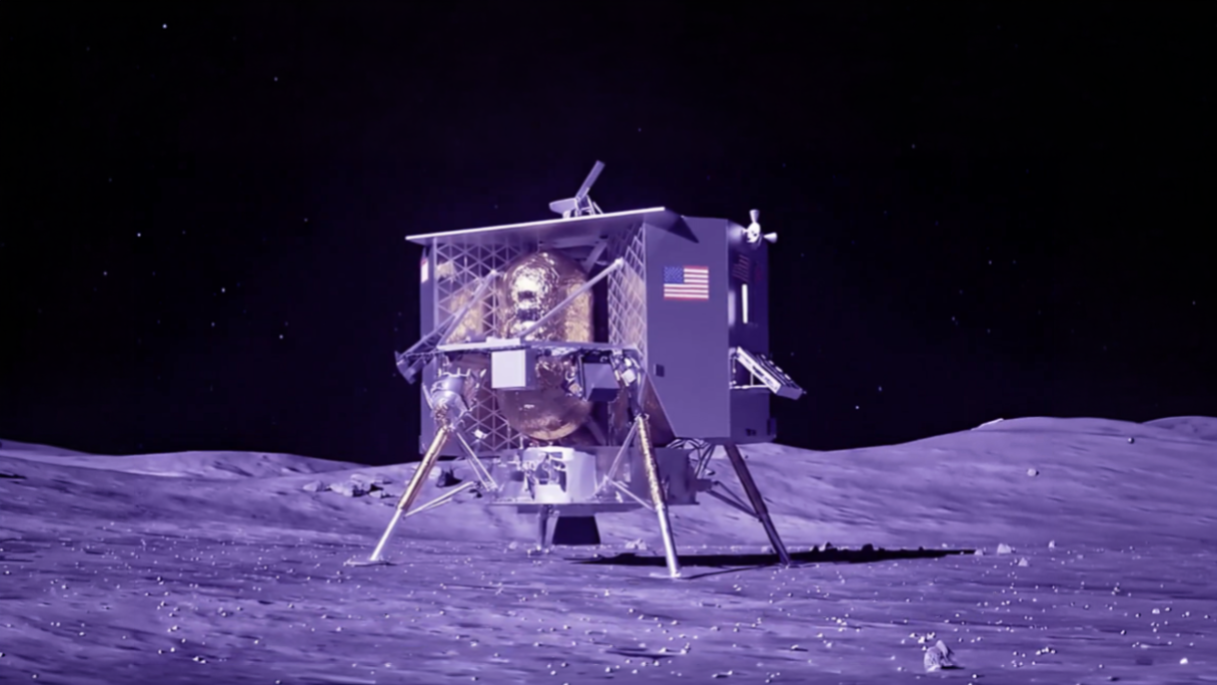
Voyager’s small-class lander, Peregrine, is sized for a smaller launch vehicle at just over eight feet wide and available for safe and affordable lunar delivery for small-scale payloads. On its maiden voyage in 2024, Peregrine carried 21 payloads in cislunar space for just over ten days, traveling more than 535,000 miles. In June 2026, NASA announced two additional Moon Base task orders that will send two Peregrine lunar landers to the Moon by the end of 2028.
The landers provide payloads power, communication and thermal support throughout surface missions. There’s remaining payload space available for both missions for commercial, government, academic or international customers, but three NASA payloads are already manifested to be delivered to a site near the Gruithuisen Domes on the lunar near side. NASA’s Linear Energy Transfer Spectrometer will monitor the lunar radiation environment, the Stereo Cameras for Lunar Plume Surface Studies camera system will observe how engine exhaust interacts with the lunar surface during descent and NASA’s Laser Retroreflector Array will serve as a permanent optical reference point for future missions.
“The goal has always been to make space accessible, and that’s what we’re doing with these three Moon Base missions,” said John Thornton, executive vice president of Lunar Systems, Voyager. “We’re providing the payload space to expand opportunities for commercial, academic and international partners, while also providing the capabilities to make America’s Moon Base and lunar activity routine.”