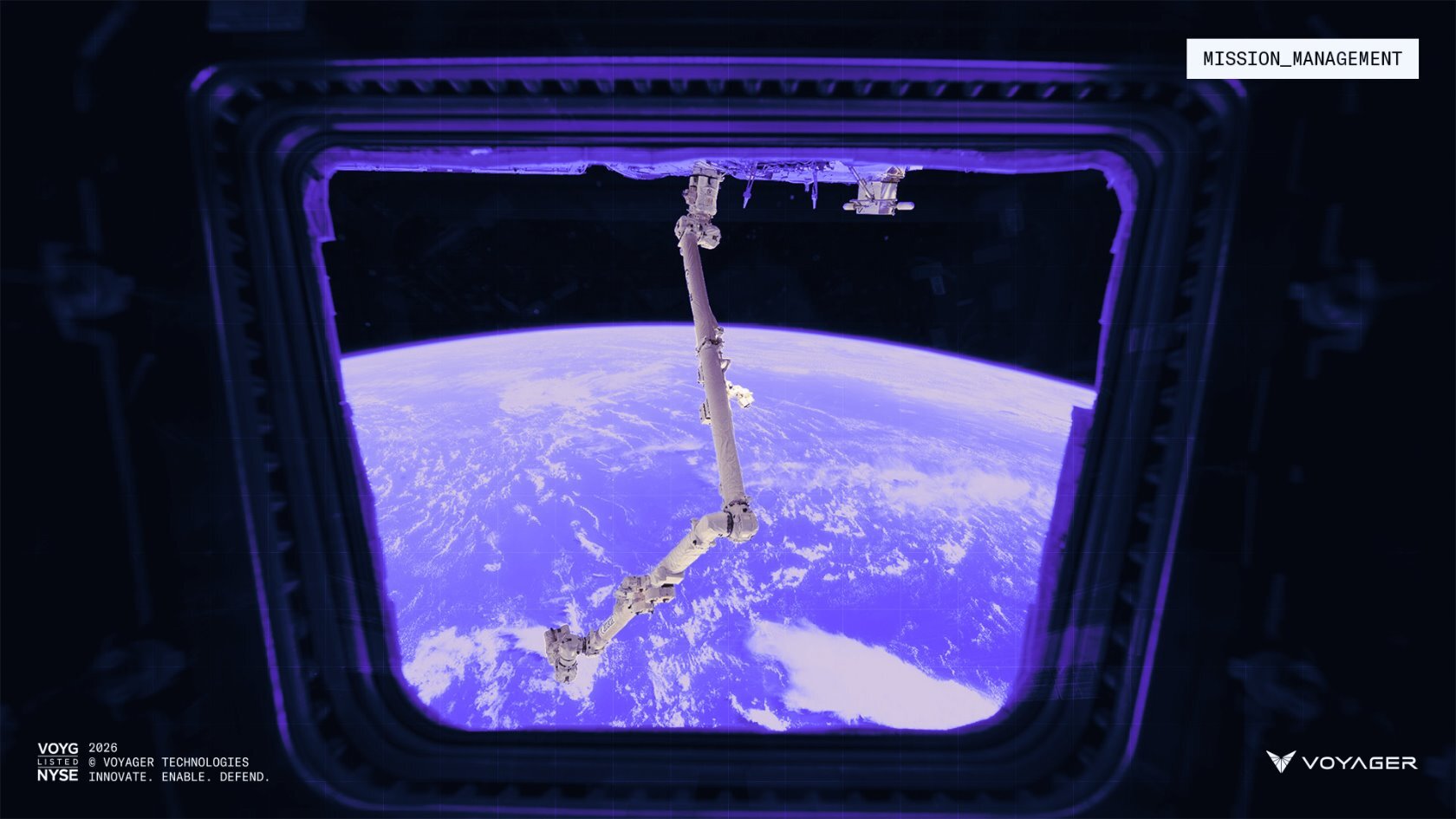
End-to-end, Voyager ensures mission continuity across platforms.
A commercial low-Earth orbit economy strengthens U.S. presence in all of space. The technologies stress-tested and validated there create the research pipeline for understanding how to survive on the lunar surface and in deep-space, while also advancing national security. The microgravity environment unlocks possibilities that span industries: biopharmaceuticals, semiconductors, space agriculture technology, optics and more.
But for organizations whose expertise is science, not spaceflight, the complexity of getting missions to orbit can create an impassable hurdle. Voyager creates a clear path to orbit with our mission management service.
“We’re the one-stop shop for access to space,” said Mike Lewis, senior vice president, Government Programs, Voyager. “We’ve enabled customer payloads from 36 nations across more than 1,400 missions, all with the goal of making access to low-Earth orbit routine and accessible for as many customers as possible.”
Truly End-to-End
Voyager has sent payloads to orbit for over two decades. With 12 active International Space Station research facilities and the Bishop Airlock, the only permanent commercial airlock aboard the station, Voyager is the first and largest ISS implementation partner, flying roughly half of all ISS National Lab payloads and a quarter of all science and technology-rated payloads. They’ve made space accessible for universities, governmental agencies and commercial and defense industries alike.
End-to-end mission management begins long before launch day. From the start, mission managers and engineers work alongside customers to develop concepts of operation, navigate safety regulations and customize platforms to fit the mission and the customer’s needs. This early collaboration ensures a clean execution later.
Safety is important on Earth, but it’s non-negotiable in space. If a common material like tin, which is prone to fracturing and whiskering, is coating a screw, slivers of the metal could be sucked into a cooling fan and risk short-circuiting critical systems. Every payload Voyager certifies is assessed at that granular level of detail to ensure the safety of the astronaut crew and station. The safety process includes an assessment and preparation of flight data package, hazard analysis and reporting, a complete safety verification process, structural and thermal analysis, and software assurance. Each material, down to the nuts and bolts holding it together, is evaluated and cleared.
Once safety certification is complete, payload manifesting and launch details are ironed out. Voyager is also responsible for payload operations, including on-orbit crew and ground personnel training and certification. The company provides detailed crew mockups and trainers for training initiatives as needed, including classroom instruction and simulated run-throughs. Over 30 years, Voyager has trained more than 75 astronauts to support customer payloads flown on the Space Shuttle, Mir and the International Space Station.
Every logistical detail between Earth and orbit matters, but Voyager will handle the details while customers focus on their mission.
ISS Today, Future Stations Tomorrow
Voyager was recently selected to mission manage Sandia National Laboratories’ Big Boy demonstration. The mission is designed to validate three unique technologies with direct national security applications: parallel sensor operations to improve understanding of lightning emissions and signals, characterization of the natural radiation environment, and measurement of how sensor and optics degrade under the forces of launch, vacuum and reentry.
Voyager’s scope spans the full mission lifecycle, including experiment design, payload integration, safety review, manifest, mission planning and on-orbit operations. On the ground, Voyager will integrate Big Boy with NEL, the company’s external payload platform. Once on orbit, the Space Station Remote Manipulator System (SSRMS), also known as Canadarm2, will move and mount NEL to one of the six external payload hosting sites of the Bishop Airlock, granting the payload direct access to the vacuum of space.
Big Boy is one piece of a broader momentum. In February, Voyager signed a contract with NASA’s Johnson Space Center to continue to provide mission management services to the International Space Station. And even more recently, Voyager announced a partnership with Reditus Space to serve as implementation partner aboard their autonomous, reusable re-entry vehicle, ENOS. Voyager’s mission management service will guide commercial and government customers through payload development, hardware qualification and mission integration.
“A commercial low-Earth orbit economy improves lives on Earth,” said Matt Magaña, president, Space, Defense and National Security, Voyager. “We’ve seen biopharmaceutical breakthroughs from the research done in microgravity, and what we build in LEO expands what’s possible for human presence on either side of it.”