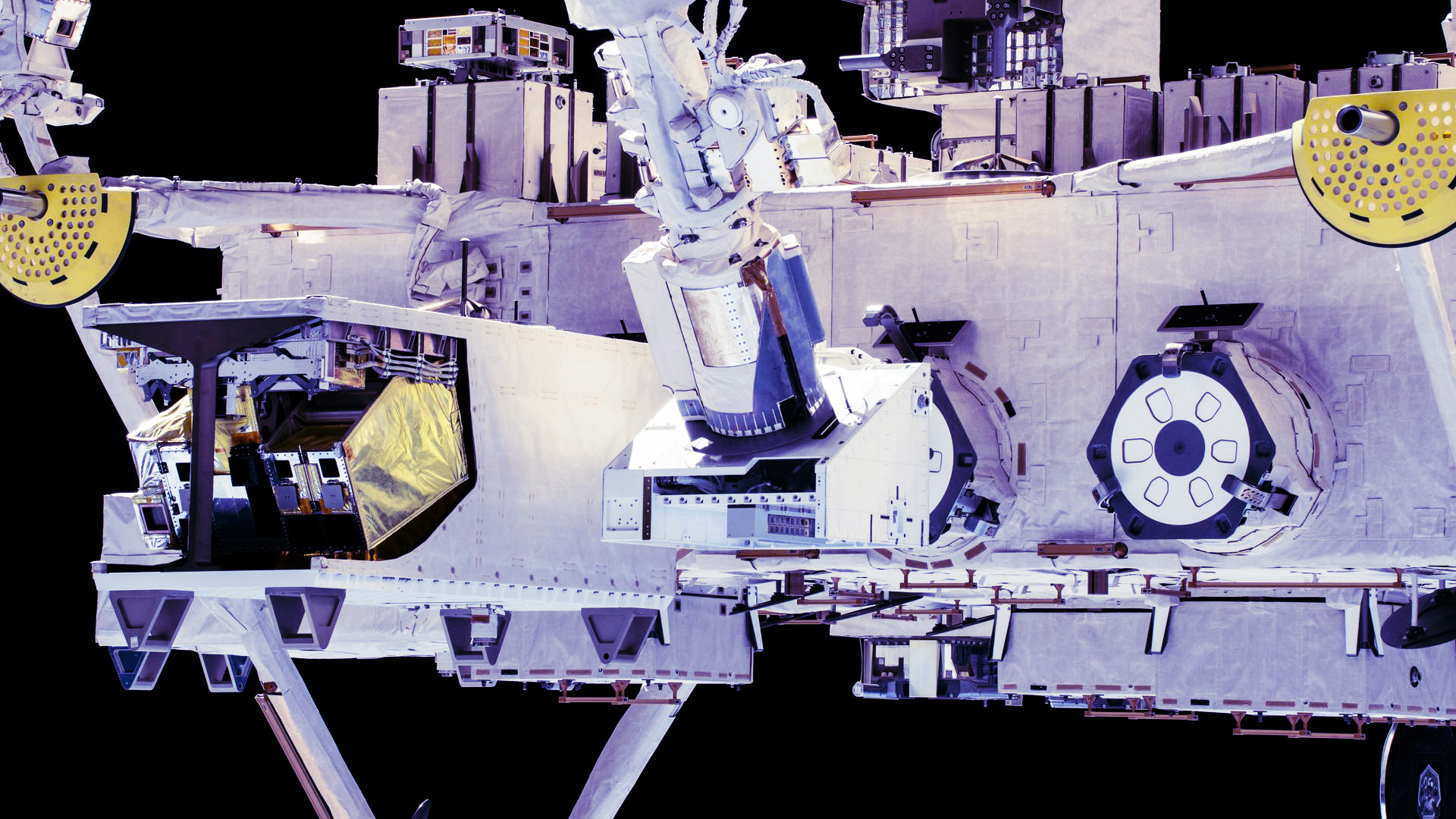
Voyager’s NREP external platform aboard the International Space Station was recently decommissioned after ten years, eight of which were spent directly exposed to the vacuum of space. The first-of-its-kind commercial external platform was able to host payloads in the harsh environment outside of the Space Station — radiation, vacuum and extreme temperature swings — while enabling the ability to return payloads to customers.
Voyager has always sought to deliver regular access to low Earth orbit for commercial, government and international customers. Understanding how materials behave in the relevant environment of microgravity and in vacuum remains critical to the success of future exploration and missions.
“We give customers access to research inside and outside of the Space Station,” said Matt Magaña, president, Space, Defense & National Security, Voyager. “As an implementation partner, we have the experience and infrastructure to put customers where they need to be. NREP and its successor are important parts of that story.”
The Legacy of NREP
Voyager’s commercial activity in LEO began in 2009. The company used the standard CubeSat size framework, a 10cm cube, to create standardized, plug-and-play microgravity research modules called NanoLabs. Multiple modules could plug directly into research platforms inside the Space Station, allowing researchers, universities and students to focus on science and data collection rather than designing custom aerospace hardware for each mission.
In 2013, Voyager became the first private company to coordinate small satellite deployments from the Space Station. The company deployed commercial small satellites from other platforms, as well, including the Cygnus spacecraft, India’s Polar Satellite Launch Vehicle and SpaceX’s Falcon 9. These satellites were released into orbit and could send data back to Earth. Yet, there was no simple, cost-effective way to give science access to the vacuum while also being able to return the payload. Voyager’s NREP External Platform was designed to solve that capability gap.
Operational beginning in August 2016, NREP was purpose-built to host payloads on the exterior of the Space Station, granting them access to the harsh space environment while also enabling their return to customers for the first time. The platform had nine slots that could be configured to handle payloads of different combinations and sizes. NREP was also small enough to be assembled inside the Space Station, sent through an airlock and installed externally with the use of a robotic arm controlled from the ground. This meant astronauts didn’t need to suit up for spacewalks in order to retrieve the device, allowing for science to be conducted more routinely.
NREP was decommissioned early September 3, 2026, making way for Voyager’s new external platform, NEL, which represents yet another Voyager first: an external platform operational through Voyager’s Bishop Airlock, the only commercial airlock aboard the Space Station.
The Next Generation
“While NREP could look in one direction and provide roughly 50 watts of power, NEL can point in any direction and provide up to 700 watts of power,” said Scott Rodriguez, vice president of Government Programs, Voyager. “That additional power is one of the most critical developments. It allows for missions that weren’t possible on NREP and it’s why customer demand has been so high.”
The first NEL is scheduled to launch in December 2026, with a waiting line of task orders. A second NEL will join in 2027.
Sandia National Labs’ Big Boy demonstration is set to be one of the inaugural missions made possible by NEL. Voyager serves as end-to-end mission manager for the demonstration and validation of on-orbit operations of parallel sensors to improve understanding of lightning emissions and signals, the natural radiation environment, and sensor and optics degradation when exposed to launch, vacuum and reentry forces. Big Boy will fly in 2027 and underscores the importance of both continued commercial LEO access and infrastructure that can meet the mission.
Whereas NREP operated through the JAXA module, Kibo; NEL interfaces directly with Voyager’s Bishop Airlock, which was berthed to Node 3, the Tranquility module, in December 2020. NEL can host up to 10 payloads and affixes to a payload transfer flight support equipment on the interior of the airlock. When ready, the Space Station Remote Manipulator System, Canadarm2, removes Bishop from the station so NEL can be disengaged from the interior of the airlock and bolted to one of six external hosting sites where it stays for the duration of the experiment before it’s brought back inside.
Expanding access to space is at the core of Voyager’s space solutions team, and NEL is the next phase of that access.