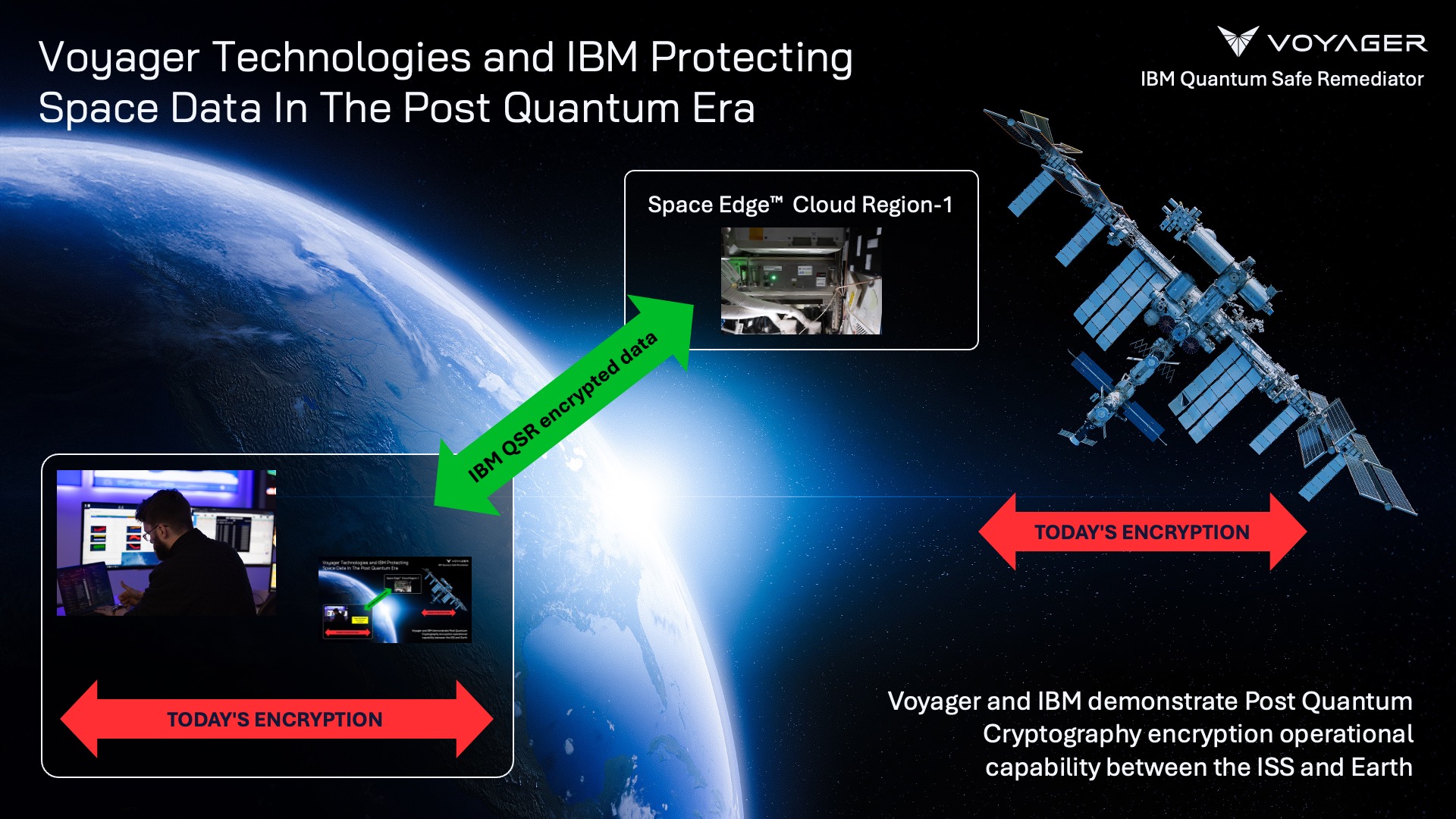
Space Edge™ Enables Crypto-agility
Many experts in the field of post-quantum cryptography (PQC) pinpoint the end of this decade as the “danger zone” for traditional encryption — the timeframe in which it is likely that a quantum computer will be available with the capability to break some of today’s encryption. However, nothing is stopping hackers from harvesting data now and decrypting it later once more advanced technology is available, including “cryptographically relevant” quantum computers. From that point of view, all data is already in the danger zone.
The need for terrestrial data security in systems managed by banks and healthcare providers is apparent, but the information from satellites needs to be secured, as well. Satellite information has been shown to be at risk using off-the-shelf satellite dishes and television equipment. With more than 12,000 satellites in orbit, serving government, military and commercial applications that span everything from powering weather forecasts to supporting our national defense posture, the importance of securing space-generated data is growing more vital by the day.
“Communications and orbital computing are rapidly becoming critical infrastructure in space,” said Dennis Gatens, president of LEOcloud at Voyager. “Before, data was generated in space and brought back to Earth to analyze. Now, it’s happening on-orbit and it’s important to maintain the integrity and security of that data,”
This is why Voyager, in collaboration with IBM, is charging ahead of the industry and proving the capability to deliver post-quantum security in space, today.
Setting the Post-Quantum Standard
In 2024, the National Institute of Standards and Technology (NIST) published their first batch of PQC standards. These three algorithms, of which IBM contributed two, are designed to remain secure even against quantum attacks, and they act as the blueprints that governments and industries worldwide will use to adopt PQC security strategies.
One of the challenges facing the adoption of PQC standards is that many devices have embedded encryption that can be difficult to upgrade, especially in space. Advancing to a new standard of encryption could often mean replacing expensive hardware. That is why IBM created IBM Quantum Safe Remediator — IBM’s crypto‑agility software designed to support hybrid classical and post‑quantum cryptography during transition, enabling secure communication for legacy applications without requiring application code changes.
“IBM Quantum Safe Remediator acts as an intelligent proxy around a legacy application. To the outside world, that facade speaks post-quantum cryptography,” said Ray Harishankar, an IBM Fellow for Quantum Safe. “Internally, it speaks classical encryption, granting the ability to upgrade existing cryptography from classical to post-quantum.”
When Infrastructure Enables Advancement
In September 2025, Voyager launched the Space Edge™ Micro Datacenter to the International Space Station. Space Edge is a cloud infrastructure that enables the migration and operation of applications in space.
Most recently, Space Edge hosted an instance of IBM Quantum Safe Remediator bringing post-quantum security to the ISS.
By deploying IBM Quantum Safe Remediator on Voyager’s Space Edge, a post-quantum-secured communication link was demonstrated between Space Edge on the ISS and users on Earth. The demonstration proved that not only is it possible to secure traffic between Earth and orbit with PQC, but the capability exists today.
“We may be tempted to think it’s just one link we need to secure, but we should expand that mindset,” said JR Rao, IBM Fellow and CTO for Security Research. “As we move forward with lunar and deep space missions, we need infrastructure with crypto-agility — the ability to replace cryptographic algorithms in an agile fashion.”
Enabling adaptable, system-wide security is where Space Edge is designed to operate. Rather than solving for today’s security weak points, Space Edge gives customers the flexibility to customize and update how their data is processed and protected.
Quantum computing is advancing quickly. NIST has mandated all U.S. government agencies adopt a PQC posture by 2035, so there is no better time than the present to ensure data is secure to NIST’s PQC standards. Voyager and IBM demonstrated the first essential step toward protecting LEO and lunar data with PQC.
Building a secure future in space requires forward-looking technologies and current-day infrastructure that can work hand-in-hand, and Voyager’s Space Edge is enabling just that.