How Voyager handles the complexity so you don’t have to.
Voyager’s end-to-end mission management services lets researchers stay focused on what matters: the science that will ultimately improve lives on Earth.
For a researcher developing a novel biopharmaceutical, the goal is never to become an expert in orbital mechanics, payload integration, or on-orbit operations. The goal is science and research, and what that can do for patients and the future of medicine.
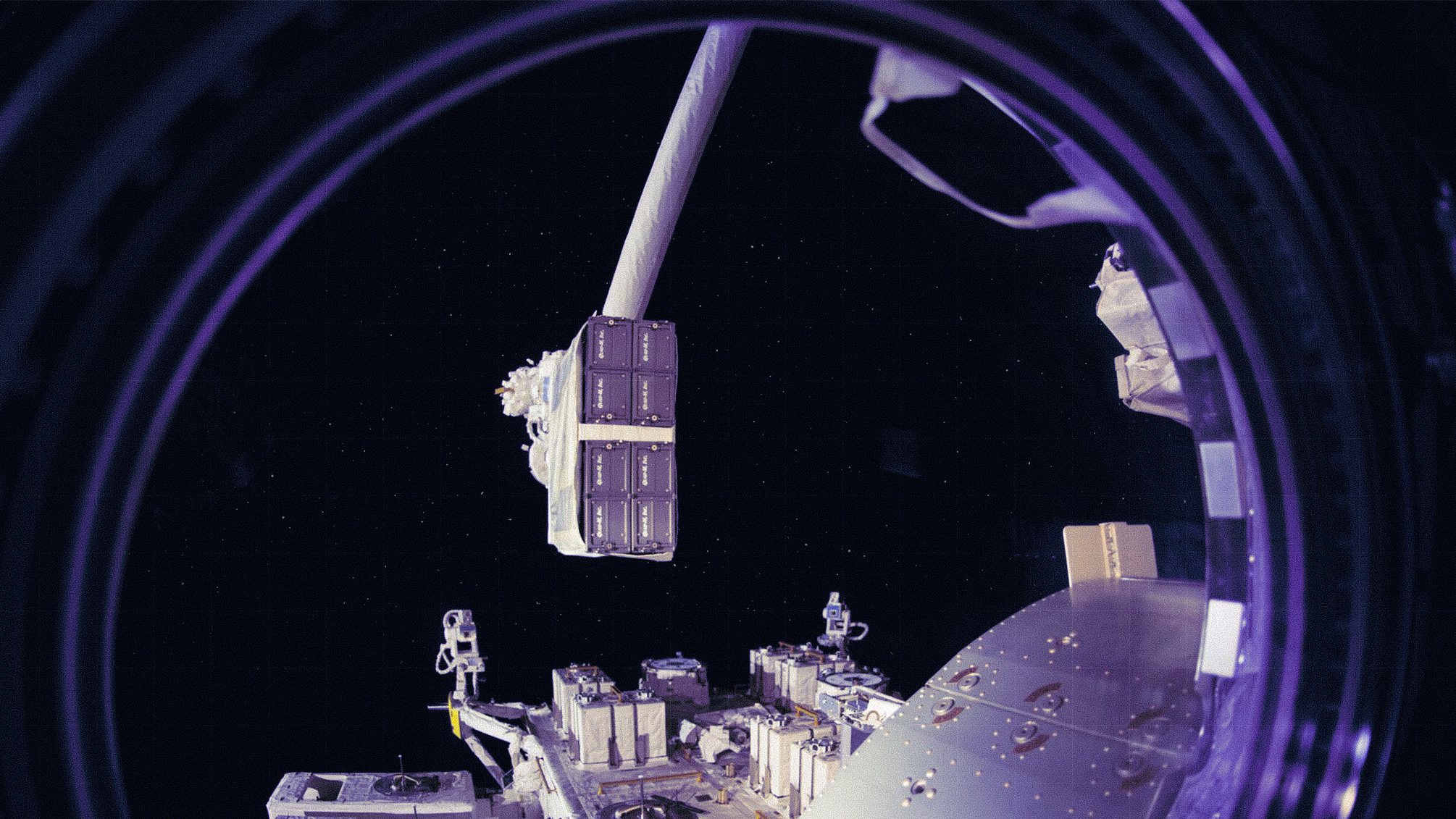
As a mission management service provider, Voyager handles everything required to get a customer’s research safely to orbit and successfully through its mission, from payload configuration, safety reviews and launch integration to on-orbit operations and data return. Customers bring the research. Voyager brings everything else.
Research that returns, and comes back again
The proof is in the partnerships that grow over time. South Korea-based Space LiinTech first worked with Voyager on a protein crystallization study, using advanced optical technology to observe how protein crystals form in microgravity. Many diseases stem from malfunctioning proteins and understanding their structure is fundamental to better treatment. In low-Earth orbit, crystals grow larger and with fewer defects than on Earth, making them far easier to analyze. It is one of the most active research categories aboard the International Space Station for exactly that reason.
The science worked. So did the mission management. Space LiinTech has since contracted Voyager to manage five missions in total.
“Customers come back because the science worked and because our mission management makes it easy for them,” said Matt Magaña, president of Space, Defense and National Security, Voyager. “Space LiinTech trusting us with their missions is a vote of confidence in our mission management capabilities and the commercial model we’ve built.”
The second Space LiinTech mission, scheduled for launch in late 2026, scales up the original work. The payload will expand the original protein crystallization study at twice the scale of the first mission, with an AI-driven automation and monitoring system designed to support onboard experiment monitoring, crystal-growth data processing, and payload-level decision support. The three additional missions are under contract.
Our work with Voyager is helping Space LiinTech turn ISS protein crystallization into a repeatable commercial pathway for microgravity-enabled biopharmaceutical research,” said Dr. Hargsoon Yoon, CEO of Space LiinTech. “As we build what we believe to be the first AI-enabled space biopharmaceutical platform dedicated to microgravity-based protein crystallization, Voyager’s mission management allows us to focus on the science, payload and platform.Across all of them, Voyager serves as a single point of accountability: mission integration, payload configuration, end-to-end operational guidance and access to orbit. Researchers do not need to build or maintain any of that infrastructure themselves. They need to focus on the science.
An Ecosystem Built for Scale
Space LiinTech recently became a tenant at VISTA, or Voyager Institute for Space, Technology and Advancement, located on the campus of The Ohio State University. VISTA is a first-of-its-kind U.S. science park that brings together companies, universities and capital to move in-space ideas from research to real-world application.
For a company like Space LiinTech, VISTA means access to its operational ecosystem, a clear path to future platforms such as Starlab, and a community of partners whose work compounds on itself. The science park is the connective tissue of a commercial space economy that is designed to keep working.
“Partnerships like the one we have with Space LiinTech are how connections become repeatable commercial capability in LEO and beyond,” said Jeffrey Manber, special representative to the Chairman and CEO, Voyager.
The Mission Behind the Missions
Every protein crystallization study that succeeds in microgravity is a step toward a better drug solving unmet medical needs. Every repeat mission is evidence that the commercial model works. And every customer that can focus entirely on their research, rather than on the operational complexity of spaceflight, is a customer whose science has a better chance of making a difference.
That is what Voyager’s mission management is for: to make sure the science is in the spotlight.